
South Asian Heritage Month: More Than a History, A Living Legacy
Each year, South Asian Heritage Month provides an opportunity to celebrate the remarkable contribution of people with roots in India, Pakistan, Bangladesh, Sri Lanka, Nepal, Bhutan and the Maldives. It is a time to reflect on history, honour achievement and recognise the rich cultures that continue to shape modern Britain.

Yet South Asian Heritage Month is about far more than food, fashion, festivals and famous names. It is about people. It is about journeys. It is about sacrifice, resilience and the determination to build a better future for the generations that follow.
For many families, the South Asian story is one of movement across continents and oceans. Some arrived in Britain directly from South Asia. Others travelled through East Africa, the Caribbean, the Middle East or elsewhere before making the United Kingdom their home.
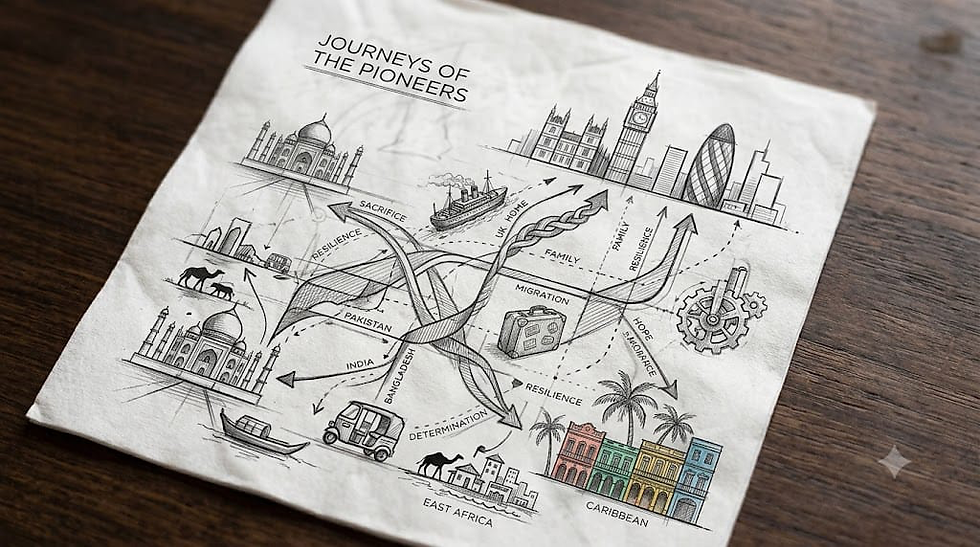
Their journeys were rarely easy.
Many arrived with little money, few possessions and limited support networks. They encountered unfamiliar cultures, harsh weather, language barriers and, in some cases, prejudice and discrimination. Yet despite these challenges, they persevered. They worked long hours in factories, mills, shops, foundries, public services and small family businesses. They helped rebuild post-war Britain while simultaneously building new lives for themselves and their families.

Today, the contribution of South Asians can be seen in every corner of British society.
They serve as doctors, nurses, teachers, engineers, scientists, entrepreneurs, artists, academics, civil servants, police officers and elected representatives. They have enriched the nation's economy, strengthened public services and contributed significantly to the cultural fabric of the country.
The National Health Service provides one of the clearest examples. Generations of South Asian doctors, nurses and healthcare professionals have cared for millions of patients and continue to play a vital role in maintaining one of Britain's most valued institutions.

The business community tells a similar story. Small corner shops evolved into successful enterprises. Family-run businesses became national companies. Entrepreneurs created jobs, generated wealth and invested in communities. What began as determination to survive often became a legacy of opportunity for others.
Yet South Asian Heritage Month is not simply a celebration of success.
It is also an opportunity to remember the values that enabled that success.
Across South Asian cultures, there is often a strong emphasis on family, education, service, perseverance and community. These values have helped countless individuals overcome obstacles and create opportunities for future generations.

Many parents and grandparents made enormous sacrifices so that their children could enjoy better lives. They worked shifts that others would not take. They accepted hardships that others would avoid. They often placed the needs of their families above their own ambitions.
The qualifications displayed on office walls, the professional careers enjoyed by many today and the opportunities available to younger generations are frequently built upon sacrifices made decades earlier.
South Asian Heritage Month also reminds us that identity is not fixed.
Many people navigate multiple identities every day. They are proudly British and proudly connected to their ancestral heritage. They speak with local accents while maintaining cultural traditions. They celebrate national events whilst preserving family customs.
This is not a contradiction.
It is one of Britain's greatest strengths.

Modern Britain has been shaped by centuries of migration, exchange and adaptation. Diversity is not something new to be tolerated. It is a reality to be embraced and a strength to be valued.
The South Asian experience demonstrates that people do not need to abandon their heritage in order to contribute fully to society. In fact, it is often the richness of different experiences, perspectives and traditions that drives innovation, understanding and progress.
There are also important lessons for future generations.
In an age dominated by social media, instant communication and rapid change, there is a danger that we lose sight of the stories that brought us here. Many young people know little about the struggles faced by previous generations. They see the achievements but not the sacrifices. They see the destination but not the journey.
South Asian Heritage Month encourages those conversations.
It encourages families to share stories.
Stories of migration.
Stories of courage.
Stories of hardship.
Stories of hope.
Because heritage is not simply something that happened in the past. It is a living connection between generations.
It shapes how we see ourselves and how we understand our place in the world.
The month also provides an opportunity to build bridges between communities. Understanding one another's histories fosters empathy and respect. It reminds us that behind every surname, every accent and every family story lies a shared human experience of aspiration, challenge and belonging.
Perhaps the greatest lesson of South Asian Heritage Month is that success is rarely achieved alone.
Communities thrive when people support one another.
Nations prosper when they draw strength from their diversity.
Individuals flourish when they understand both where they come from and where they wish to go.

As we celebrate South Asian Heritage Month, we honour those who came before us, recognise those who contribute today and inspire those who will shape tomorrow.
Their stories are not merely South Asian stories.
They are British stories.
They are stories of resilience, service, contribution and hope.
And they continue to be written every single day.
As we reflect on the sacrifices of previous generations and the opportunities we enjoy today, perhaps the most important question is this:
If future generations look back on our lives fifty years from now, what legacy will they say we left behind for them?


Comments