
Four Stages of Decline: Lessons from Athens, Sicily, Persia and the Modern World
Empires rise with purpose bright,
Built by toil and guided light.
Yet power whispers, pride takes hold,
And wisdom's voice grows faint and cold.
The walls stand firm, the banners fly,
The markets thrive, the fortunes rise.
But history asks, before the fall,
Did anyone hear the warning call?
For nations rarely fail in haste,
Their strength dissolves through subtle waste.
The final blow is seldom new,
It comes when old mistakes break through.

History often teaches its most important lessons through repetition. Different people, different places, different centuries, yet remarkably similar outcomes. One of the most powerful historical examples is the decline of Athens during the Peloponnesian War. What began as a confident and successful power gradually weakened through a sequence of decisions that proved fatal.
Many historians argue that this pattern has appeared repeatedly throughout history. Empires and nations rarely collapse because of a single battle or one disastrous decision. Instead, decline often unfolds through four recognisable stages.
Stage One: Success Creates Confidence
Every great power begins with genuine achievement.
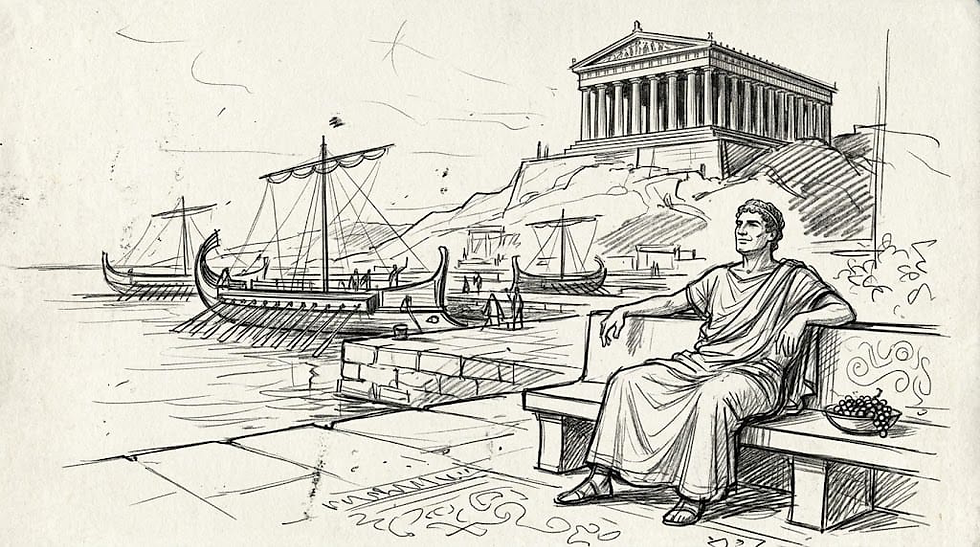
Athens became wealthy through trade, naval power, innovation and effective leadership. Its citizens believed in their institutions and their future. Success attracted talent, investment and influence.
This stage is healthy and necessary. Confidence enables progress. It encourages ambition and risk-taking. People believe tomorrow can be better than today.
The danger emerges when confidence gradually transforms into certainty.
When a nation begins to believe that its success is permanent, it starts to ignore the very qualities that created that success in the first place. Humility disappears. Criticism becomes unwelcome. Success becomes an entitlement rather than an achievement.
History shows that no civilisation is exempt from this temptation.
Stage Two: Arrogance Replaces Prudence
The second stage begins when confidence turns into overconfidence.
For Athens, this was symbolised by the Sicilian Expedition. Despite warnings from experienced voices, Athens launched an enormous military venture far from home.

The campaign promised wealth, prestige and strategic advantage. Its supporters argued that Athens was too powerful to fail.
The reality proved very different.
Resources were stretched. Objectives became unclear. Decision-makers became trapped by their own assumptions.
This stage is not simply about military adventures. It applies equally to economics, politics and culture.
Nations begin taking risks they would once have considered reckless. Leaders become convinced that past success guarantees future success. Institutions stop questioning themselves.
The most dangerous phrase in any empire may be:
"It will be different this time."
History repeatedly demonstrates that it rarely is.
Stage Three: Internal Division Weakens the Core
Once mistakes begin to accumulate, a society faces a choice.
It can honestly assess what has gone wrong and make corrections.

Or it can begin blaming itself.
Athens increasingly became divided. Political factions fought one another. Citizens lost confidence in institutions. Trust began to erode.
The greatest threat was no longer external.
It was internal.
This stage appears in almost every declining power. The energy once directed towards building the future becomes focused on internal disputes.
Groups stop seeing themselves as members of a shared community.
Common purpose disappears.
Short-term interests replace long-term thinking.
Political victory becomes more important than national success.

The tragedy is that societies often remain wealthy and powerful during this stage. Because decline has not yet become obvious, many people convince themselves that everything remains normal.
The foundations, however, are already weakening.
The structure still stands, but cracks are appearing beneath the surface.
Stage Four: External Reality Arrives
The final stage occurs when external events expose weaknesses that have accumulated over many years.
For Athens, the disaster in Sicily destroyed military strength, confidence and prestige. Enemies recognised vulnerability and acted accordingly.
The collapse did not happen because of a single battle.
The battle merely revealed problems that already existed.
This is a crucial lesson.
Most great powers do not fall because an enemy suddenly becomes stronger.
They fall because they have become weaker.
External challenges are inevitable.
Economic crises, military conflicts, demographic changes, technological disruption and geopolitical competition have always existed.
The decisive question is whether a society remains resilient enough to respond.
If the foundations are sound, challenges can be overcome.
If the foundations have eroded, even relatively small pressures can trigger major consequences.

The Persian Lesson
One reason the story remains relevant today is that other civilisations learned different lessons.
Persia, despite suffering defeats, often demonstrated remarkable patience and strategic thinking. Rather than responding emotionally to every setback, Persian rulers frequently focused on endurance, adaptation and long-term positioning.
History repeatedly rewards those who think in decades rather than days.
The nations that survive are not always the strongest.
They are often the most adaptable.
They understand that temporary victories can create complacency, while temporary setbacks can create resilience.

Why This Matters Today
Every generation believes it is living through unique circumstances.
Technology changes.
Governments change.
Economic systems evolve.
Yet human nature remains remarkably consistent.
Pride still exists.
Greed still exists.
Fear still exists.
Wisdom still matters.
The four stages of decline are not confined to nations. They apply to businesses, organisations, communities and even individuals.
A successful company becomes arrogant.
A community stops investing in its values.
A family loses its sense of shared responsibility.
An individual mistakes achievement for invincibility.
The pattern repeats at every level.
The challenge is recognising the warning signs before the final stage arrives.
Can we still listen to criticism?
Can we still change course?
Can we still place long-term wellbeing above short-term gain?
Can we still distinguish confidence from arrogance?
These questions determine whether success becomes sustainable or self-destructive.
The Real Measure of Strength
The lesson from Athens is not that decline is inevitable.
The lesson is that decline begins long before people notice it.
A society's true strength is not measured by its wealth, military power or technological sophistication.
It is measured by its ability to remain humble during success, prudent during prosperity, united during disagreement and resilient during adversity.
The greatest civilisations are not those that never face challenges.
They are those that continually renew themselves.
History does not simply record what happened.
It whispers warnings to those willing to listen.
The shelves behind every historian are filled with stories of nations that believed they were different.
Most discovered they were not.
A Question for the Reader
If the four stages of decline are confidence, arrogance, division and exposure, then where do you think your nation, your community, your organisation, or even your own life stands today?


Comments