
The Thread That Remembers: Why Raksha Bandhan Still Matters in the 21st Century
- 2 days ago
- 6 min read
A hand reaches across a small space.
Another hand waits.
Around a wrist, a thread is tied.
It is delicate enough to snap between two fingers. It weighs almost nothing. It may cost only a few pounds, perhaps even a few pence. Yet within that tiny knot can rest the weight of an entire lifetime.
Childhood.
Arguments.
Laughter.
Shared meals.
Secret loyalties.
Long separations.
Old wounds.
Forgiveness.
Home.
And somewhere within it all, an unspoken promise: whatever life becomes, somewhere in this world there is someone who remembers who you were before the world told you who you ought to be.

That is the quiet beauty of Raksha Bandhan.
In the 21st century, when so much of life is measured by value, speed, productivity and price, the rakhi offers a gentle contradiction.
Some of the things that matter most cost almost nothing.
A thread can carry what money cannot buy.
It can carry memory.
The meaning behind the thread:
There is something profoundly human about tying a knot.
We tie things because we do not want them to come apart.
Perhaps that is why the rakhi remains such a powerful symbol. The thread itself is fragile, but the relationship it represents is asked to be stronger.
Hands that once fought over toys meet again across the years. The wrist that once wore a brightly coloured childhood rakhi may now carry a watch, the responsibilities of a career, the strain of parenthood and the invisible marks of everything adulthood has demanded.
Still, for a moment, the years fall away.
A sister ties the thread.
A brother lowers his wrist.
And somewhere between the knot and the silence, childhood returns.

Some knots hold cloth together.
Others hold memory together.
When childhood becomes memory
As children, siblings rarely understand the significance of having one another.
Brothers annoy sisters.
Sisters expose brothers.
They argue about bedrooms, television channels, possessions, parental favouritism and who started what.
Raksha Bandhan can seem wonderfully simple then. There are sweets to eat, gifts to receive and photographs to tolerate.
But childhood has an inconvenient habit of ending.
One day, the family home becomes quieter.
Parents grow older.
A sister marries.
A brother moves abroad.
Careers begin.
Children are born.
Responsibilities multiply.
The rooms in which siblings once quarrelled belong to somebody else, or remain exactly as they were while everyone who once filled them has moved on.
And then something extraordinary happens.
The sibling who once irritated you becomes one of the few people left who remembers the original version of you.
They remember your childhood nickname.
They remember Father's old car.
They remember Mother's voice calling everyone to dinner.
They remember the holiday when everything went wrong and somehow became one of the family's favourite stories.
They remember who you were before the job title, the mortgage, the grey hair and the carefully constructed adult life.
There is enormous comfort in being remembered that way.
Raksha Bandhan in a connected but distant world
We live in an age of unprecedented communication.
A photograph can cross continents instantly. Families scattered between Birmingham, Mumbai, Dubai, London, Toronto and New York can appear on the same screen within seconds.

Yet technological connection is not necessarily human closeness.
We can know what someone ate for dinner without knowing that they are lonely.
We can see their holiday photographs without knowing that their marriage is struggling.
We can send a birthday message in three seconds while somehow finding no time for a meaningful conversation in twelve months.
Perhaps this is why Raksha Bandhan matters more, not less, in the modern world.
A rakhi may now arrive through the post. It may be ordered online. A sister may watch through a telephone screen while her brother ties it around his own wrist thousands of miles away.
Technology carries the ritual.
Love must still carry the relationship.
Because meaningful bonds cannot survive on notifications alone.
They require time.
They require effort.
They require forgiveness.
They require presence.
Protection means something different now
Traditionally, Raksha Bandhan has often been understood through the idea of a sister tying a rakhi around her brother's wrist and the brother promising to protect her.
There is tenderness in that promise.
But the 21st century invites us to deepen it.
Protection does not need to suggest that a woman is weak or that a man must always be strong.
Anyone who has lived long enough knows that strength moves between people.
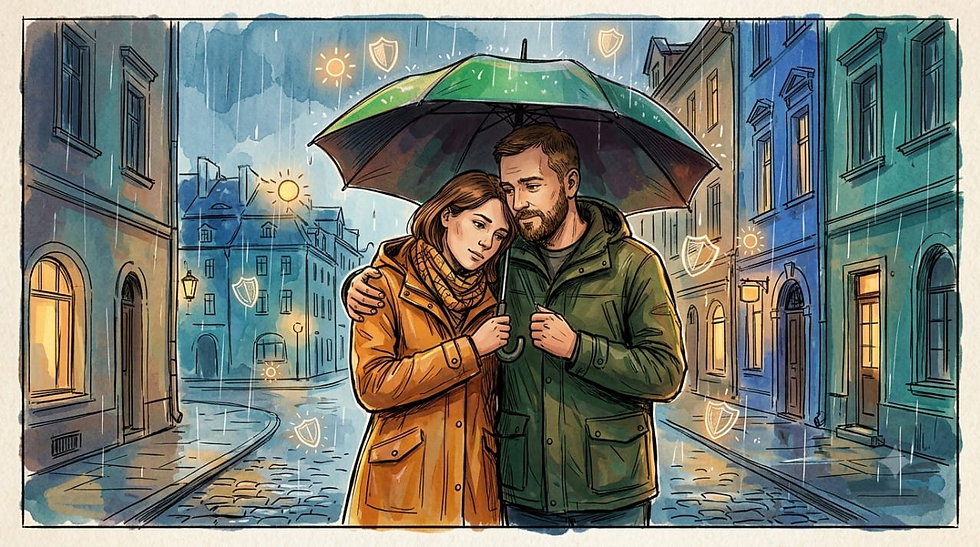
There are days when a brother protects his sister.
There are other days when she protects him.
She may recognise the sadness he hides from everyone else.
She may challenge him when pride has made him foolish.
She may defend him when others misunderstand him.
She may sit beside him when there is no solution to offer.
And sometimes that is protection too.
Protection can mean listening.
It can mean making the telephone call nobody wants to make.
It can mean saying, "You were wrong," because love sometimes requires courage rather than agreement.
It can mean forgiving something that happened twenty years ago.
Perhaps the modern promise of Raksha Bandhan is therefore not:
"I will protect you."
Perhaps it is:
"I will stand beside you, and you will stand beside me."
The families we choose
Not every brother or sister shares our blood.
Life has a habit of giving us siblings in unexpected forms.
A cousin who grew up beside us.
A childhood friend who became family.
A neighbour who remained through every crisis.
Someone who entered our lives much later but somehow understood us immediately.
This does not diminish the cultural meaning of Raksha Bandhan. Instead, it reminds us of the larger truth sitting quietly beneath the tradition.
Blood can create kinship.
But loyalty can create family.
Kindness can create family.
Shared struggle can create family.
Staying can create family.
A thread across continents
For migrant and diaspora families, festivals carry another kind of significance.
They become bridges.
A rakhi arriving through a Birmingham letterbox may have begun its journey thousands of miles away. Inside that small envelope may be the scent of another country, memories of grandparents, fragments of a childhood language and the imagined warmth of hands that cannot physically reach across the distance.

Migration changes families.
Children grow up between cultures. Grandchildren speak differently from grandparents. Homes are created far from ancestral homes.
Yet rituals travel.
And through them, memory travels too.
The thread around the wrist becomes a thread across geography.
From one generation to another.
From one home to another.
From where we live to where some part of us still belongs.
What cannot be bought:
Naturally, the modern world has discovered how to commercialise Raksha Bandhan.
There are designer rakhis, luxury gifts, elaborate hampers, online deliveries and carefully arranged social-media photographs.
There is nothing wrong with celebration.
But the most expensive rakhi cannot repair a neglected relationship.
The greatest gift might cost nothing.
A promise kept.
A visit made.
A grudge released.
An elderly brother remembered.
A lonely sister telephoned.
An apology finally offered.
Love has never been impressed by packaging.
The Raksha Bandhan that eventually comes
There is another truth we seldom speak about.
Families do not remain physically together forever.
Eventually, for many of us, there comes a festival when someone is missing.
A chair remains empty.
A photograph becomes precious.
A telephone number remains stored in a mobile phone although we know nobody will ever answer it again.
A wrist that once received the thread survives only in memory.
And suddenly, all the arguments that once seemed so important become very small.
Time is merciless in teaching us the value of people.
So perhaps Raksha Bandhan carries an urgent lesson beneath its gentle ritual.
Do not postpone love.
Do not allow pride to become stronger than affection.
Do not assume there will always be another year, another festival, another visit or another telephone call.
Say what matters while the person can still hear it.
The thread that remains
Perhaps this is why Raksha Bandhan still matters.
Not because the world has remained unchanged, but because it has changed so much.
In a restless century of migration, technology, ambition and distraction, this small thread asks us to remember something ancient and necessary.
Remember one another.
Show up.
Forgive.
Stay connected.
Protect one another from loneliness as much as from danger.
Remember where you came from.
Because when careers end, houses change hands, possessions disappear and photographs begin to fade, we rarely remember the people who were merely present during our successes.
We remember those who remained during our storms.
And so once again, a hand reaches across a small space.
A thread circles a wrist.
A knot is tied.
It looks almost insignificant.

Yet perhaps it is saying something enormous:
I remember you.
I value you.
Whatever years may come between us, some part of your story will always live inside mine.
And perhaps that is the true gift of Raksha Bandhan.
So, as another year passes and another thread is tied, is there a brother, a sister, or someone who became family along the way whom you should call, visit, forgive, thank, hold a little closer, or simply remind:
"I am still here for you"?


Comments