
The Pencil’s Tale: A Story About Becoming Who We Were Meant to Be
- Jan 31
- 4 min read
Sometimes the simplest stories carry the deepest truths. The Pencil’s Tale is one of them — a small, gentle reminder that wisdom doesn’t always arrive wrapped in grand speeches or complicated theories. Sometimes it comes in the shape of an ordinary pencil lying quietly on a desk. And yet, this little pencil has a message that every single person — young or old, confident or struggling, unsure or determined — deserves to hear.

The Pencil’s Tale speaks to something universal in us:
the desire to grow, to make a difference, to leave a mark, and to understand who we really are. It reminds us that greatness is not loud. Transformation does not always announce itself. And the tools for becoming better are often already in our hands.
1. “Everything you do leaves a mark.”
The pencil begins its lesson with a simple truth: no matter how small we feel, every action, every decision, every conversation leaves a trace.
A kind word can echo in someone’s heart for years. A careless comment can wound without us ever realising. We move through the world shaping it — sometimes gently, sometimes sharply — but always leaving something behind.
Just like a pencil gliding across a page, our lives write stories through:
how we treat people
how we show up in moments of difficulty
how we respond when no one is watching
We may underestimate ourselves, but life doesn’t. Life records everything.
The Pencil’s Tale whispers:
Be mindful. Be intentional. What you leave behind becomes part of you.

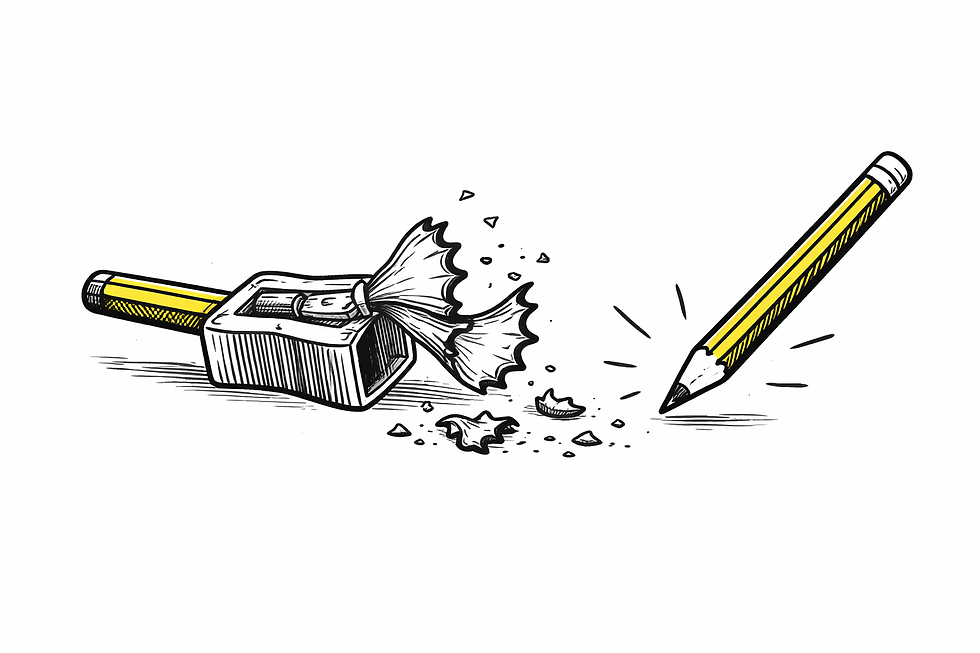
2. “Sharpening makes you better — even though it hurts.”
Every pencil must be sharpened before it can write clearly. And every human being learns, grows, and deepens through challenges. Pain, discomfort, and difficulty are not punishments— they are sharpeners.
The times you felt lost…
The mistakes that made you rethink everything…
The moments that pushed you to choose courage over comfort…
Those weren’t signs of failure. Those were the sharpenings that prepared you for clarity, strength, and purpose.
We don’t always like the process, but the pencil reminds us:
Growth rarely comes without pressure. But the point that emerges is worth it.
3. “You can correct your mistakes.”
A pencil carries an eraser not because it expects to fail, but because it expects to learn. There is deep beauty in that. We often treat mistakes as something shameful or final. We hold on to guilt, replay moments we wish we could change, or freeze in fear of getting things wrong.
But The Pencil’s Tale brings kindness back into the picture:
Mistakes don’t define you.
They refine you.
The ability to erase, revise, and try again is not weakness.
It is what makes you human — and what makes you capable of becoming better than you were yesterday.
Life is not about writing a perfect story. It’s about editing courageously.

4. “What matters most is inside.”
A pencil’s outer wood can crack, fade, or get scratched — but its purpose remains intact as long as the graphite inside is whole.
In the same way, what truly defines us is not:
how we look
what we own
the labels people place upon us
or the roles we perform
Our worth rests in our inner character — in the values we hold tightly and the intentions we carry quietly.
If the world judges the outside, the pencil teaches us to cultivate the inside:
kindness, humility, integrity, compassion, and sincerity.
Your real strength is invisible — but unmistakable.

5. “You are guided by a hand greater than your own.”
Perhaps the most comforting part of The Pencil’s Tale is this:
the pencil never writes alone. There is always a hand holding it, guiding it, steadying it, and giving meaning to each stroke. For many, that guiding hand is faith. For others, it is purpose, conscience, or a deep sense of direction they cannot always explain.
You don’t have to know exactly where your story is going.
You don’t have to control every line.
You just have to trust that you are being shaped, supported, and guided.
There is peace in knowing you are not navigating life alone.

Why This Tale Matters Now More Than Ever
We live in a world filled with noise, pressure, comparison, and speed. Everyone seems to be racing, polishing their image, fearing mistakes, or hiding their struggles.
But the Pencil’s Tale pulls us back to gentler wisdom:
You are allowed to grow slowly.
You are allowed to feel unsure.
You are allowed to make changes.
You are allowed to be imperfect.
You are allowed to be guided.
This is not a tale about becoming flawless.
It is a tale about becoming real.
About choosing intention over impulse.
Connection over ego.
Meaning over noise.
The pencil does not try to be a pen, or a brush, or something grander than it is.
It simply embraces its purpose — and through that simplicity, it becomes powerful.
Maybe that is what we need too.
Final Reflection
When we think about our own lives — our struggles, our hopes, our relationships, our legacy — the pencil’s quiet wisdom becomes more than a metaphor.
It becomes an invitation.
An invitation to pause, sharpen, forgive, reflect, and trust.
And so, the tale leaves us with one sharp question:
What kind of mark do you want your life to leave behind?


Comments