
The Machine Remembers Yesterday, but the Human Heart Dreams of Tomorrow
Why the future of humanity will depend on something no machine can truly call its own: the human imagination.
There is something extraordinary about the human mind.
It can sit in an empty room and imagine a city that has never existed. It can look at a struggling child and see a future scientist. It can hear a few notes of music and begin composing a melody that nobody has heard before.
And it can look at the world as it is, with all its imperfections, and quietly ask, "What if things could be different?"
Artificial intelligence can do remarkable things. It can examine millions of documents, recognise patterns, solve complex problems and produce answers in seconds. It can even generate paintings, stories and ideas that surprise us.
Yet there is a distinction worth exploring.
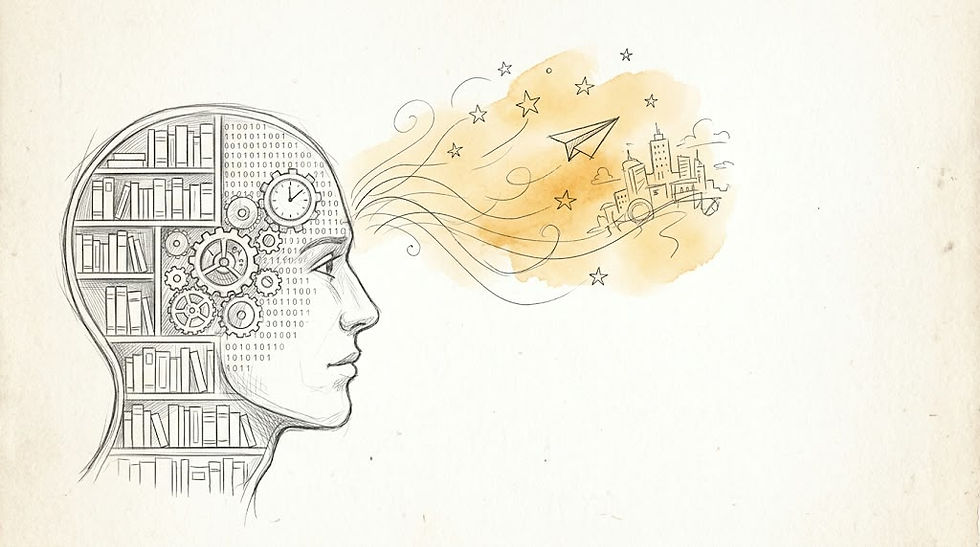
AI learns from what humanity has already created. Human imagination gives us the courage to create what does not yet exist.
This is not an argument against technology. It is an invitation to understand what makes us human, especially at a time when machines are becoming increasingly capable of doing things we once believed belonged entirely to us.
Yesterday Is a Wonderful Teacher, but a Poor Place to Live
Imagine walking into a library containing almost everything humanity has ever written.
Every discovery, mistake, argument, invention and extraordinary achievement is there, waiting to be explored.
Now imagine a machine that can read much of that library, identify connections and offer you an answer before you have finished asking your question.
That, in simple terms, captures something important about modern AI.

Its capabilities emerge largely from learning patterns in existing information. It uses those patterns to generate responses, make predictions and sometimes produce genuinely unexpected combinations.
But information has a history. It reflects what people have experienced, recorded, believed and chosen to preserve.
And history, however valuable, cannot tell us everything about tomorrow.
Consider the first person who imagined that human beings might fly.
For centuries, people watched birds crossing the sky. They studied wings, wind and movement. Some built machines that failed spectacularly.
The Wright brothers eventually succeeded because they combined existing knowledge with experimentation, persistence and a willingness to challenge assumptions.
They learnt from yesterday, but they were working towards a tomorrow nobody had experienced.

That is the beauty of imagination. It allows us to begin with the familiar and reach towards the unknown.
The Difference Between Knowing and Wondering
Think about a child holding a cardboard box.
An adult might see packaging that needs recycling.
The child sees a spaceship.
Within minutes, the living room becomes another planet, the sofa becomes a mountain range and an ordinary Tuesday afternoon turns into an adventure.
No sophisticated technology is required. The child simply imagines another possibility.
As we grow older, something changes.
We become increasingly concerned with evidence, precedent, probability and what other people might think. We learn to ask whether an idea is realistic before allowing ourselves to explore whether it is worthwhile.
These questions have their place. Experience helps us exercise judgement.
But sometimes our greatest limitation is the belief that tomorrow must resemble yesterday.
AI can help us challenge that belief by suggesting unfamiliar approaches. Yet humans bring something else to the conversation: lived experience, personal values, emotional understanding and a sense of purpose.
We can decide that a future is worth pursuing even when the evidence of the past offers little encouragement.
And sometimes that decision changes everything.
A Small Poem for the Future
The machine can read a thousand years,
Of victories won and silent tears.
It knows the words that others said,
The roads once walked, the lives once led.
But somewhere in a child's bright eyes,
A world unseen begins to rise.
A question forms, a dream takes flight,
A little hope becomes a light.
For knowledge tells us where we've been,
And shows us much we've heard and seen.
Yet dreams invite the heart to go,
Beyond the things we think we know.
So let the machines recall the past,
And help us build a future vast.
But never lose that human art,
Of seeing tomorrow in the heart.
The Teacher Who Sees What the Data Cannot
Consider a teacher working with a pupil who has struggled academically.

The data tells a disappointing story. Assessment results are poor. Attendance has been inconsistent. Progress has been slower than expected.
An AI system might identify the pupil as being at risk of underachievement. That could be valuable. It might recommend targeted support or identify gaps in learning.
But a good teacher looks beyond the figures.
Perhaps the pupil has responsibilities at home. Perhaps confidence has been damaged by repeated disappointment. Perhaps nobody has ever told them that they are capable of achieving something extraordinary.
The teacher notices a small spark of curiosity and chooses to nurture it.
A conversation leads to encouragement. Encouragement builds confidence. Confidence creates effort, and effort gradually opens doors.
Years later, that pupil might become the very person who helps another struggling child discover their potential.
The data was not necessarily wrong. It was simply incomplete.
It described what had happened without determining what had to happen next.
One of the most powerful things a human being can offer another is belief in a future that has not yet been earned or proved.
When Technology Meets Humanity
The danger is not that AI will become more intelligent.
The greater danger is that we may gradually stop exercising our own imagination because technology makes it so convenient to think on our behalf.
Why wrestle with a difficult question when an answer appears instantly?
Why experiment with an uncertain idea when a machine can offer ten polished alternatives?
Why spend an afternoon writing something imperfect when a beautifully structured article can be generated in seconds?
Convenience is attractive. But creativity often grows through struggle.
The awkward first sentence, the unsuccessful experiment, the conversation that changes our thinking, the idea that emerges during a quiet walk: these experiences help us develop judgement and discover what matters to us.
AI need not diminish any of this.
Used thoughtfully, it can become a remarkable creative partner. It can help a scientist explore possibilities, a doctor interpret information, a teacher personalise learning or a writer discover a different perspective.
Indeed, AI can already generate ideas that appear novel and creatively valuable. It would be misleading to claim that machines can only repeat the past.
The deeper distinction lies in human intention.
A machine may propose a hundred possible futures. We must still decide which ones are worth creating, whose lives they will improve and what responsibilities come with them.
That is where knowledge meets conscience.
The Future Still Needs Dreamers
Imagine the world fifty years from now.
AI may have transformed medicine, education, scientific research and everyday life in ways we can barely comprehend today.
Diseases might become treatable. Learning could become more accessible. Discoveries that once required decades might happen in months.
But the questions that matter most will remain profoundly human.
Will those advances reach the people who need them?
Will we create societies where children feel valued?
Will progress bring greater dignity, fairness and opportunity?
Will we use the time technology gives us to strengthen our relationships, or simply fill our days with more activity?

These are choices about the kind of world we want to inhabit.
The past provides wisdom. Technology gives us powerful tools. Creativity helps us imagine alternatives. Compassion reminds us why those alternatives matter.
And courage allows us to pursue them.
Perhaps the greatest opportunity of the AI age is that we can combine extraordinary machine capability with the imagination, judgement and kindness of human beings.
We do not need to compete with machines at remembering everything.
We need to become better at asking what is worth remembering, what deserves to change and what kind of tomorrow we want to leave behind.
Because the finest achievements of humanity began long before there was evidence that they were possible.
They began when someone dared to imagine.
And somewhere today, a child is looking at an ordinary cardboard box and seeing a spaceship.
We would do well to protect that gift.
So, as artificial intelligence becomes increasingly capable of telling us what we can do, will we still have the imagination, courage and humanity to decide what we should do?


Comments