
The Forgotten Minds of Bengal: Genius, Recognition and the Questions History Leaves Behind
South Asian Heritage Month invites us to celebrate the achievements of those who shaped our world. Yet it should also encourage us to ask difficult questions about recognition, power and whose stories are remembered.
Recently, I came across a documentary exploring a provocative claim: that some of Bengal's greatest thinkers, scientists and innovators never received the global recognition they deserved. Whether every claim withstands historical scrutiny is less important than the wider question it raises. How many brilliant minds have contributed to humanity without receiving the honours, prizes or fame that others enjoy?
Few regions have produced such an extraordinary concentration of intellectual talent as Bengal.
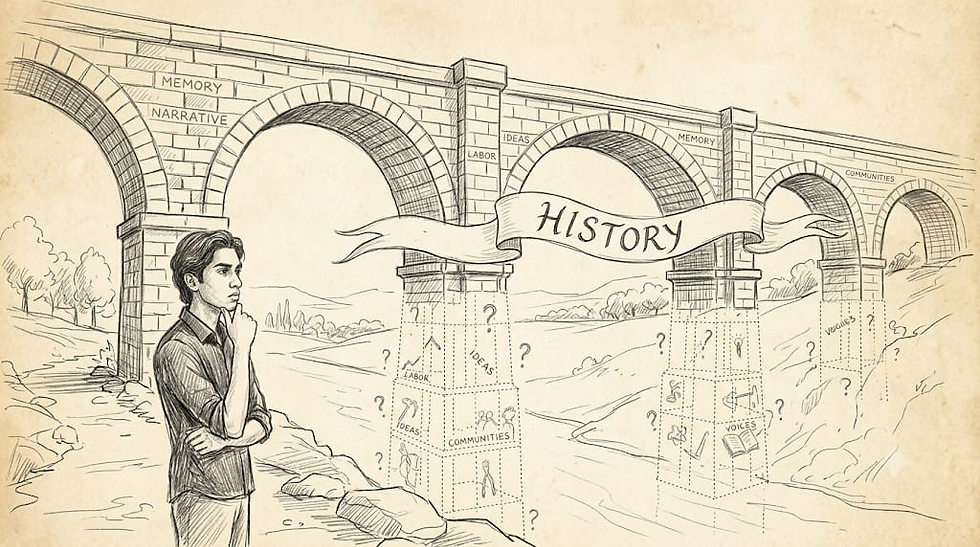
In the late nineteenth and early twentieth centuries, Calcutta was one of the intellectual capitals of the world. Universities, research institutes, literary societies and scientific circles flourished. The city became a meeting place for philosophers, mathematicians, scientists, economists, writers and reformers whose ideas would shape modern life.

Yet many outside South Asia know surprisingly little about their contributions.
Take the example of Sir Jagadish Chandra Bose.
Long before wireless communication became a global industry, Bose was conducting pioneering experiments in radio waves. His work laid important foundations for wireless transmission. He also undertook remarkable research into plant physiology, demonstrating responses in plants that challenged conventional scientific thinking.

Today, wireless technology underpins mobile phones, satellite communications, broadcasting and the internet itself. Yet Bose's name remains far less familiar than many of those who followed.
Then there was Satyendra Nath Bose.
His collaboration with Albert Einstein led to the development of Bose-Einstein statistics, one of the cornerstones of quantum physics. Every physics student encounters the term "boson", named in his honour. The Higgs boson, one of the most significant scientific discoveries of recent times, carries his legacy in its very name.

Yet despite transforming modern physics, he never received a Nobel Prize.
The story prompts reflection. Is recognition always a perfect measure of contribution?

History suggests otherwise.
Many discoveries emerge through collaboration, competition and cumulative effort. Some individuals happen to be in the right place at the right time. Others work quietly in the background while their ideas are developed further by those with greater access, influence or visibility.
The Nobel Prize itself, prestigious though it is, has never been immune from controversy. Outstanding individuals across multiple disciplines have been overlooked throughout its history.
The Bengali experience highlights a broader truth.
Talent is universal.
Recognition is not.
This observation extends beyond science.
Bengal gave the world Rabindranath Tagore, the first non-European Nobel Laureate in Literature. His poetry, philosophy and educational ideas continue to inspire readers across the globe. His influence extends far beyond literature into music, culture and social thought.
His success demonstrated that intellectual excellence was not confined to Europe or North America.
Yet countless others worked with equal passion and dedication without achieving similar global acclaim.

South Asian Heritage Month provides an opportunity to revisit these stories because they challenge simplistic assumptions about innovation and progress.
Modern society often celebrates the final inventor, the successful entrepreneur or the public face of a breakthrough. We rarely celebrate the generations of thinkers whose work made those achievements possible.
Every smartphone contains technologies built upon decades of scientific discovery.
Every medical treatment rests upon thousands of experiments conducted by researchers whose names are now forgotten.
Every major advancement is usually the result of collective human endeavour rather than individual genius alone.
The Bengali intellectual tradition illustrates this perfectly.
It reminds us that progress does not emerge in isolation.
It emerges from classrooms, laboratories, libraries and conversations.
It emerges from curiosity.
It emerges from education.
It emerges from people who ask questions others are unwilling to ask.
Perhaps that is why Bengal became such a powerful centre of learning.
There existed a culture that valued education not simply as a route to employment, but as a route to understanding. Knowledge was respected. Debate was encouraged. Scholarship was celebrated.
The result was an environment capable of producing extraordinary minds.

There is another lesson here for the twenty-first century.
Many young people today grow up in a world obsessed with visibility. Social media followers, public profiles and personal branding often appear to determine success.
The stories of Bengal's overlooked pioneers offer a different perspective.
Their contribution was not dependent upon applause.
Their value was not measured by awards.
Their impact did not disappear because recognition was delayed or incomplete.
The technologies we use, the scientific principles we rely upon and the intellectual traditions we inherit continue to benefit humanity regardless of whether their creators became household names.
That is a powerful reminder.
Success and significance are not always the same thing.
A person can profoundly influence the world without receiving the highest honours.
A discovery can transform society without making its creator famous.
A contribution can endure long after public recognition fades.
For those of South Asian heritage, these stories are a source of pride.
Not because they encourage resentment or grievance, but because they demonstrate the remarkable capacity of human intellect to flourish despite obstacles.
Many of these individuals worked during periods of colonial rule. Resources were limited. Opportunities were unequal. Access to global networks was often restricted.
Yet they persevered.
They pursued knowledge.
They challenged accepted wisdom.
And they expanded humanity's understanding of the world.
Their legacy lives on every time we make a telephone call, use wireless technology, study modern physics, engage with literature or benefit from scientific discovery.

South Asian Heritage Month is therefore not simply about remembering the past.
It is about recognising the foundations upon which our present has been built.
It is about ensuring that future generations understand that brilliance exists in every culture, every community and every corner of the world.
Most importantly, it reminds us that history is rarely complete.
There are always overlooked contributors, forgotten pioneers and untold stories waiting to be rediscovered.
As we celebrate the achievements of Bengal's great minds and reflect on the many who may never have received the recognition they deserved, perhaps the most important question is this:
How many of the ideas that shape our lives today were created by people whose names history has forgotten, and what responsibility do we have to remember them?


Comments