
How To Think Reality Into Existence
- Apr 3
- 4 min read
You are not just someone encountering ideas. You are part of the process they are pointing toward.
It is easy to treat concepts about thought and reality as something external, something to agree with or reject from a distance. But the moment you engage with them, the focus shifts inward. The real subject is not the idea itself, but you.
Your habits of thinking.
Your expectations.
Your quiet assumptions about how life works.

You do not approach anything with a blank slate. You bring your past interpretations with you. Every belief you have formed, every pattern you have repeated, sits just beneath the surface, shaping how you respond.
Some readers move through ideas like this lightly. They read, they nod, they move on. It becomes another piece of content, another moment of interest that fades as quickly as it arrives. Others feel something deeper. A pause. A sense that there might be more to examine. They do not rush to accept or reject. They stay with it a little longer. And then there are those who resist almost immediately. They feel the tension between what they believe and what is being suggested, and they close the door before exploring it further. None of these responses are wrong. But they are revealing.
Your first reaction often says more about your internal framework than the idea itself.
If you feel drawn in, it may reflect a readiness to question your patterns.
If you feel skeptical, it may reflect a need for structure and evidence.
If you feel frustrated, it may reflect past attempts that did not lead where you hoped.
All of this matters because it shapes how far you are willing to go. You might say you want change. Most people do. But wanting something and aligning with it are not the same thing. There is often a gap between intention and consistency.
That gap is where most people stop. They try something briefly. They think differently for a day or two. Then they return to what feels familiar. Not because they choose to fail, but because familiarity is comfortable. It requires less effort.
And yet, it is the repeated, familiar patterns that quietly build your experience over time.
The real question is not what you want once, but what you return to repeatedly.
What thoughts feel natural to you?
What expectations do you carry without noticing?
What assumptions shape your reactions before you have time to question them?

These are not surface-level considerations. They require attention. Not quick attention, but sustained attention. And that is where things become difficult.
Because attention today is fragmented. You are constantly moving from one thing to another. Reading, scrolling, switching. Depth is replaced by speed. Reflection is replaced by reaction.
So when you encounter an idea that asks for consistency, it can feel unnatural. You may want results quickly. You may expect clarity immediately. And when that does not happen, you move on.
But what if you did not?
What if you stayed with a single thought long enough to understand it fully?
What if you observed your own patterns without trying to fix them right away?
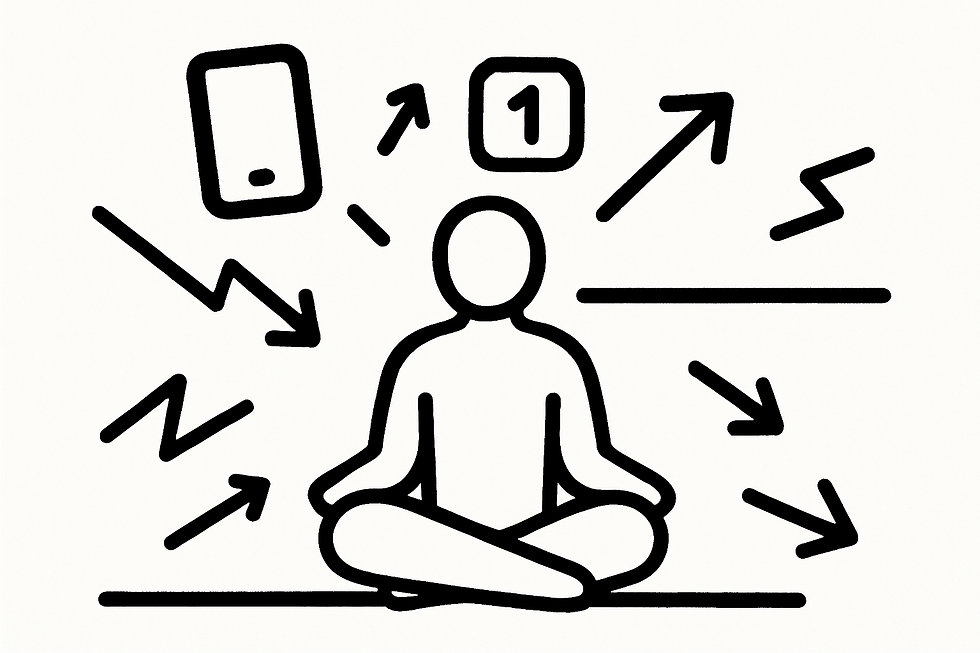
There is something that happens when you slow down in this way. You begin to notice repetition. You begin to see how certain thoughts lead to certain feelings, and how those feelings influence your actions.
It becomes less abstract.
More personal.
More real.
And in that space, something quiet begins to take shape.
A thought returns,
not loud, not new,
just something steady
you always knew.
It does not push,
it does not shout,
it waits for you
to notice it out.
In stillness it stays,
in silence it grows,
not forced ahead,
but slowly it flows.
And if you return,
again and again,
it shapes the path
you walk within.
This is not about forcing change. It is about recognising patterns and choosing whether to continue them. You are not required to be perfect. You are not expected to eliminate doubt or distraction. Those things will always be present in some form.
The difference lies in how you respond.
Do you get pulled completely into distraction, or do you notice it and return?
Do you let doubt end the process, or do you allow it to exist without giving it full control?

These are small decisions, but they matter more than they seem. Because over time, small decisions accumulate. They form direction. And direction, repeated long enough, becomes experience.
This is why the focus cannot remain on the idea alone. It has to return to you.
Not in a self-centered way, but in an aware way.
You are the one thinking the thoughts.
You are the one repeating patterns.
You are the one deciding, consciously or not, what gets your attention.
And that means you are also the one capable of observing and adjusting those patterns.
Not instantly. Not perfectly. But gradually.
That gradual shift is often overlooked because it does not feel dramatic. It does not come with clear markers or sudden breakthroughs. It is subtle.
But subtle does not mean insignificant.
It means steady.
And steady, over time, is powerful.

So instead of asking whether an idea like this works in general, consider how you are engaging with it specifically.
Are you giving it enough attention to understand it?
Are you consistent enough to see any effect?
Are you honest enough to notice your own patterns without avoiding them?
These are not easy questions. But they are necessary if you want clarity.
Because in the end, the value of any idea is not in how it sounds, but in how it interacts with your actual experience. And that interaction depends entirely on you.
So before deciding what to believe, or what to dismiss, it might be worth asking something simpler and more direct. What are you already reinforcing in your own mind, day after day, without even realising it?


Comments