
Beyond Gender: Spiritual Equality and the Integrated Human in the Qur’an
- Mar 15
- 3 min read
The Qur’an can be linked to androgyny in the sense that it emphasises a gender-neutral soul, universal moral traits, and spiritual equality — portraying human completeness as the integration of both strength and tenderness, not the dominance of one gendered quality over another.
The Qur’an does not explicitly discuss “androgyny” in the modern psychological or gender-theory sense.
However, several Qur’anic themes are often linked, in academic and theological discussions, to ideas that resemble what we might call “spiritual androgyny” — the notion that certain human qualities are not gender-restricted, and that spiritual potential transcends male/female division.

Here is a clear, explanation
1. The Qur’an Emphasises that Spiritual Worth Is Genderless
Many scholars argue that the Qur’an promotes a form of spiritual androgyny by teaching that moral, intellectual, and spiritual qualities are not assigned to one gender. Qur’anic verses repeatedly list men and women together, not as separate moral categories but as equal recipients of divine reward:
“Indeed, the Muslim men and Muslim women, the believing men and believing women… the devout, the truthful, the patient, the humble… Allah has prepared for them forgiveness and a great reward.” (33:35)
The structure of this verse suggests that essential human virtues are not gender-bound.
Qualities like humility, courage, sabr, compassion, reasoning, and devotion belong to all — which aligns with the idea that the inner human self is not defined by outward gender categories.
2. The Qur’an Describes the Human Soul (nafs) Without Gender
The Qur’an often speaks of the nafs, the self, in a way that is not male or female. Examples:
nafs al-lawwāmah (self that reproaches), nafs al-ammārah (self inclined to wrongdoing), nafs al-mutma’innah (self at peace)
These states apply to any human being, and classical scholars note that the Qur’an avoids gendering the soul. This has led some thinkers to describe the Qur’anic concept of the self as gender-neutral — the spiritual identity is not male or female. This aligns loosely with philosophical ideas of androgyny as an inner unity that transcends gender distinctions.
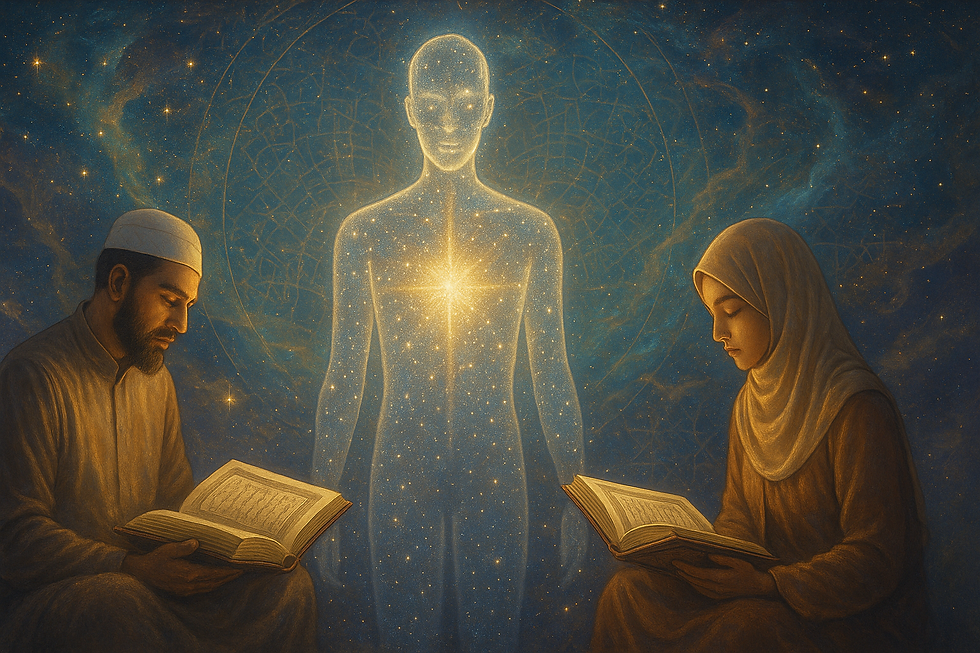
3. Adam & the Human Archetype Are Portrayed Beyond Gendered Hierarchy
When the Qur’an speaks of Adam — representing humanity — the emphasis is on:
moral responsibility, free will, learning and knowledge, nearness to God
The narrative does not elevate male over female as part of divine design. Instead, the male-female pair appears as a partnership, not a hierarchy (7:189). Some scholars interpret this as the Qur’an neutralising gender as a determinant of spiritual rank, again echoing the idea that the core human nature is not gendered.
4. The Qur’an Assigns Traditionally “Masculine” and “Feminine” Traits to All Humans
Qualities like:
mercy, gentleness, compassion, strength, courage, perseverance
are addressed to all believers, without distinction.
In Western psychology, androgyny refers to possessing both traditionally masculine and feminine traits. In this sense, the Qur’an’s call for all humans to embody rahmah (mercy) and quwwah (strength) can resemble the idea of an “integrated” human character that blends diverse traits.

5. Male/Female Are Described as Complementary, Not Oppositional
The Qur’an presents male and female as:
“created from a single soul” (4:1)
mutually protective and nurturing.
This language highlights interdependence, which some modern scholars connect to an idea of balanced human wholeness — neither gender is spiritually complete without the qualities often associated with the other. This does not mean the Qur’an promotes literal androgyny, but it does emphasise a form of spiritual balance.
6. Mystical Interpretations (Sufi Thought) Deepen the Connection
Some Sufi thinkers, such as Ibn ʿArabī and Rūmī (drawing from Qur’anic themes), describe the perfected human being (al-insān al-kāmil) as one who integrates:
firmness and softness, reason and love, jalāl (majesty) and jamāl (beauty)
These are sometimes framed as “masculine” and “feminine” divine attributes united within a single soul. This mystical reading does echo the idea of inner androgyny—a balanced human spirit mirroring divine harmony.

Important Clarification
The Qur’an does not describe people as androgynous in a biological or gender-identity sense, and it does not promote erasing gender categories.
The connection is conceptual and symbolic:
The human soul is not gendered. Virtues are universal. Spiritual rank is gender-neutral. Human wholeness requires balancing diverse traits.
These themes resemble philosophical ideas of androgyny as inner unity, balance, and integration, not gender ambiguity.


Comments